Hangzhou’s West Lake: Follow the Views Instead of Chasing a Full Circuit
West Lake is both a lake and a deliberately shaped cultural landscape. Causeways, islands, buildings and wooded hills contribute to views celebrated over centuries. A first visit can follow a short, coherent sequence of those relationships instead of treating a complete circuit as the only successful day.
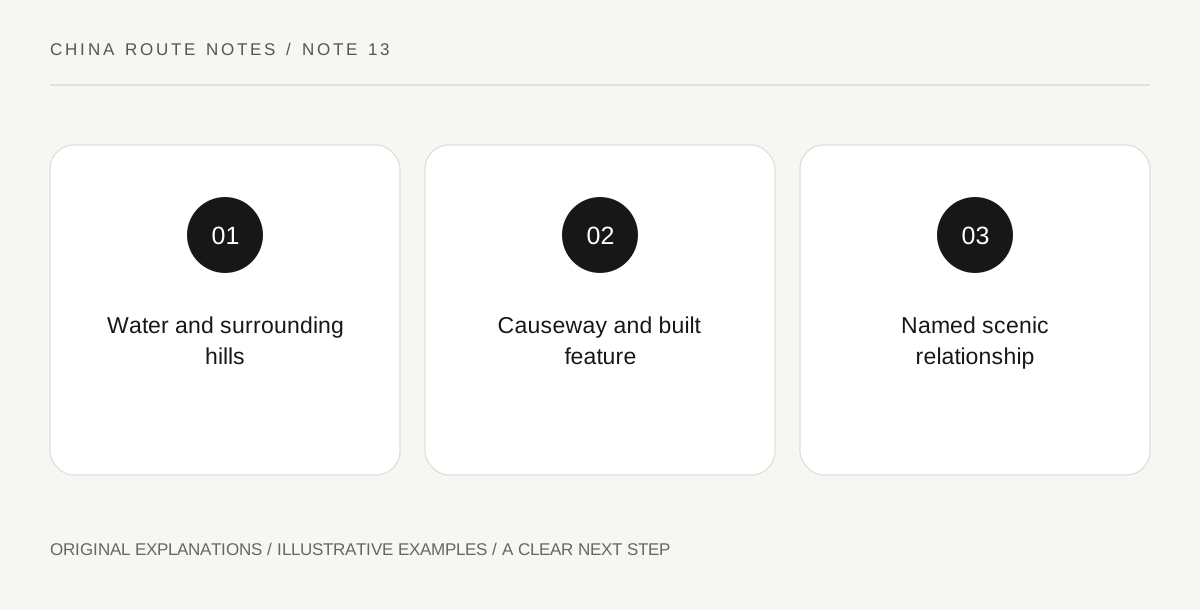
Original explanatory diagram. Read the full method and limitations below.
Recognize the human work in the landscape
UNESCO explains that West Lake’s causeways and islands developed through historical interventions and that named scenic views became part of its cultural significance. This gives you a richer starting point than the idea of a purely natural lake beside a city. Look for the relationship between water, a path or causeway, a distant built feature and the hills behind. Ask which elements appear intentionally aligned from your current viewpoint. A visible alignment is an observation; identifying a named historic scene requires a reliable label or guide. Keep those two kinds of knowledge separate in your notes.
Choose a shoreline sequence with a clear endpoint
Mark a manageable beginning and end using the current visitor map. Decide whether your interest is a causeway experience, an urban waterfront contrast or a particular cultural site, rather than collecting unrelated pins. A short section can offer water-level views, a change in framing and an opportunity to sit and look. Include the route away from the endpoint so the walk does not finish with an uncertain transfer. If you add a boat service, read its actual landing places and operating conditions. A sightseeing boat should not be assumed to stop wherever your next map pin happens to be.
Use changing weather as a different reading
The same water and hill outline can appear very different under flat light, haze or clear conditions. Observe what the weather makes visible instead of treating a scene as a failed version of a promotional photograph. Strong contrast may emphasize silhouettes; quieter light may show layers of shoreline more gradually. This is an observation exercise rather than a forecast of atmospheric effects. Check the actual weather and service notices before committing to a boat or exposed walk. If conditions make the planned route unsuitable, choose an accessible alternative with its own purpose rather than forcing the original photographic ambition.
Connect names with actual viewpoints
Historic scenic names can refer to a season, time of day or particular relationship of elements. Find a reliable explanation and compare it with the scene you can see. You do not need to reproduce the exact conditions for the name to become informative. A useful question is how words direct attention toward the landscape. Avoid assuming that every modern scenic sign identifies an unchanged ancient view. The lake has a long history of management and continued use. Let the current place, documented history and your own observations remain in conversation without collapsing them into a timeless postcard.
Illustrative short visit
A traveler selects one shoreline section and one causeway viewpoint, then identifies a convenient endpoint near an onward connection. At each stop the traveler sketches water, built features and hills. A translated scenic name adds historical context. The resulting visit has two linked observations rather than an unfinished attempt to walk every shore in one afternoon.
Practical checks
Optional checkboxes save only in this browser.
Questions that come up
Must I walk all the way around West Lake?
No. A focused section can reveal its landscape composition. Choose a route that suits the time and walking capacity available, and understand how you will leave its endpoint.
Is West Lake an untouched natural landscape?
Its heritage significance includes a long history of deliberately shaping views with causeways, islands, buildings and planting. Reading that human contribution is central to understanding the lake as a cultural landscape.
References and scope
These sources support the factual background. Examples and exercises are original illustrative teaching material. References do not imply endorsement.
- UNESCO: West Lake — Designed causeways, islands and named cultural views.