A Great Wall Visit: Look for a Defensive System in the Landscape
The Great Wall is more than a continuous line on a ridge. Towers, passes, walls and terrain worked together, and surviving sections reflect different periods and materials. A visit becomes richer when you examine one managed section closely instead of treating distance walked as the only measure of success.
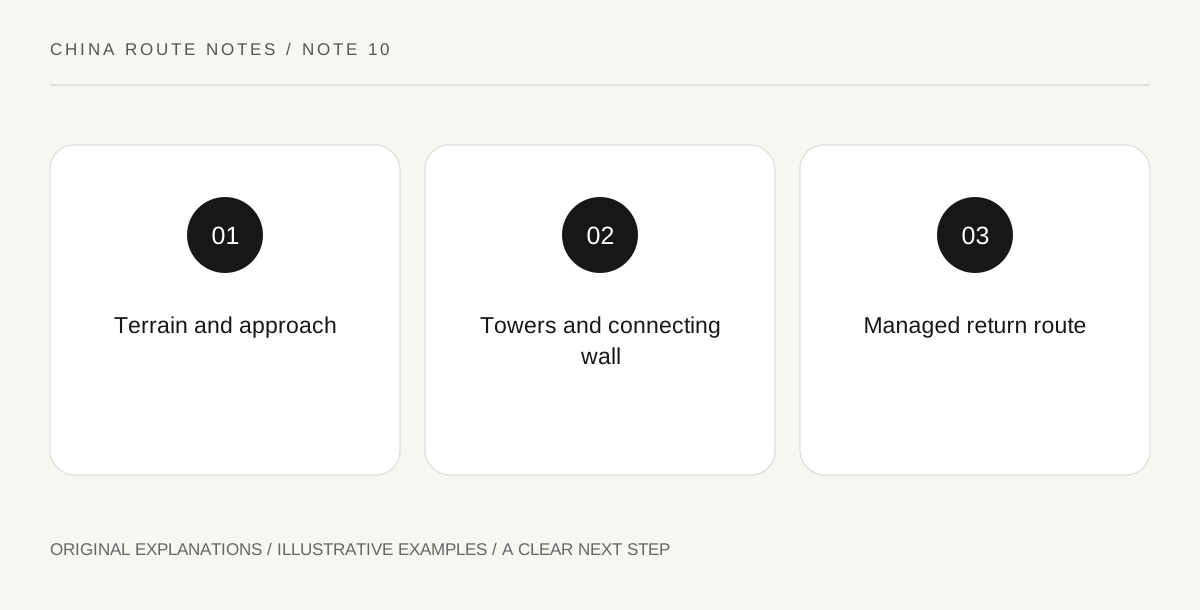
Original explanatory diagram. Read the full method and limitations below.
Replace the single-wall image with a system
UNESCO describes a long-lived defensive project containing walls, tracks, towers, shelters, fortresses and passes. That suggests a useful observation sequence: follow the wall’s relationship to the ridge, find a tower’s sightlines, then consider how movement passes through the landscape. The visible masonry at one tourist section cannot stand for every period of construction. Avoid assuming a section near Beijing represents all surviving walls in western China. A map showing different components is more informative than a single total-length number when you are trying to understand what the monument did.
Choose a managed section by access requirements
Select an officially managed visitor section and establish its actual approach, permitted walking route and return arrangements. Ask whether the accessible route reaches the experience you want, rather than whether the attraction has a cable car somewhere on the site. Steps, gradients and uneven surfaces can still matter beyond a mechanical lift. If several people are traveling together, agree where a shorter visit can end and where the group will reunite. Do not use an attractive photograph of a remote section as evidence that public access, transport or a safe route exists there.
Read towers and materials without guessing dates
From a permitted position, compare tower placement with bends, slopes and nearby approaches. Sketch where a person could see and where the terrain interrupts the view. Note visible materials and repairs, but let official interpretation establish construction phases; weathered appearance is not a reliable dating method. Restored masonry may help reveal a structural form while also requiring you to distinguish original fabric from later work. Ask a guide a precise question such as how this section’s towers communicated or controlled an approach. A focused question usually produces more useful learning than asking whether the wall is authentic.
Define the turnaround before the outward walk
Measure the day by the whole route back to transport. A descent or return across repeated stairs can feel different from the first climb, and the wall’s visible continuation does not create an obligation to follow it. Check weather and local closure notices and obey barriers. Choose a turnaround based on the group’s condition and operating arrangements, not the next tower’s apparent closeness in a photograph. This is a heritage visit on a mountain landscape, so allow observation stops without turning them into risky edge positions. An unobstructed view is never a reason to climb beyond the authorized path.
Illustrative tower study
At one managed section, a visitor chooses two publicly accessible towers and draws the slope between them. The note compares their view toward an approach route and identifies a question for the official guide about signaling. The visitor turns back at the agreed point rather than adding a distant tower simply because it becomes visible. No specific section or walking time is prescribed.
Practical checks
Optional checkboxes save only in this browser.
Questions that come up
Are all Great Wall sections the same age?
No. The defensive system developed over many periods, and surviving construction varies. Use the interpretation for the particular section you visit instead of applying one dynasty label to everything.
Is a cable car enough to make the visit step-free?
Not necessarily. It may cover only one approach segment. Ask about the entire route from arrival through viewing areas and back, including stairs, gradients and current lift operation.
References and scope
These sources support the factual background. Examples and exercises are original illustrative teaching material. References do not imply endorsement.
- UNESCO: Great Wall — Multi-period defensive system, towers, passes and varied construction.