Staying With Friends in China: Understand Accommodation Registration
A room booked in an app and a room registered with the authorities are different records. Foreign visitors staying with friends or in a private dwelling need to understand who handles accommodation registration, how the address is documented and what confirmation the process produces.
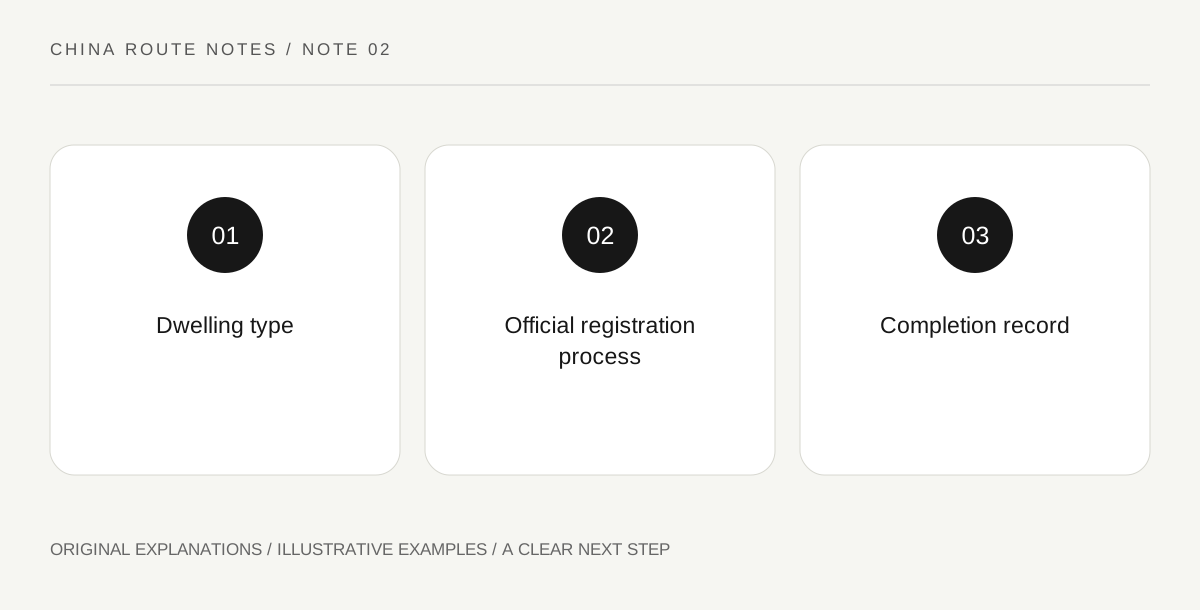
Original explanatory diagram. Read the full method and limitations below.
Identify the type of stay
Begin with the accommodation itself. Official guidance distinguishes a hotel, where registration is handled by the hotel, from other dwellings where the foreign guest or host has a registration responsibility. A short booking, serviced label or professional-looking listing does not by itself settle which procedure applies. Ask the operator directly whether it registers foreign guests and what original identification it needs. For a friend’s apartment, discuss the process before arrival so the host is not trying to establish the local procedure after the guest reaches the door late at night.
Prepare an address that belongs to the dwelling
Record the Chinese address with district, street, building and unit information, plus a reachable host contact. An English building nickname may help a visitor find a landmark but be unsuitable for a registration form. Ask which supporting accommodation documents the local process requires. The Ministry of Commerce guide describes registration within 24 hours for non-hotel accommodation and refers to documents establishing the dwelling. Use the competent local authority for the precise current evidence list. Do not send a full passport image to an unknown intermediary simply because a booking message requests it.
Use the official channel for the procedure
In March 2026, NIA published online channels for non-hotel accommodation registration, including its NIA 12367 app, WeChat and Alipay mini-programs, and government service website. These are useful starting points, but the announcement of channels is not a statement that every case is complete after opening an app. Follow the actual application prompts and local instructions, and distinguish a submitted form from an accepted registration. If the address cannot be selected or verification fails, contact the local authority promptly. Repeatedly guessing form fields can make the information less accurate.
Treat a change of dwelling as a new question
A hotel confirmation for one city should not be assumed to cover a later private stay elsewhere. Write the date you arrive at each accommodation and ask what registration follows a move. Keep the completion record accessible with travel documents while minimizing unnecessary copies. If a hotel says it cannot handle your foreign passport, ask its management to clarify the procedure before relying on the reservation. This guidance concerns accommodation reporting; it does not authorize work, extend a stay or change the conditions of entry. Those matters have their own requirements and official channels.
Illustrative host conversation
A visitor plans three hotel nights followed by a weekend at a friend’s apartment. The friend confirms the apartment’s full Chinese address and looks up the local registration channel before the visit. After arrival they complete the required process and retain its result. They do not treat the previous hotel’s check-in record as registration for the apartment.
Practical checks
Optional checkboxes save only in this browser.
Questions that come up
Is my accommodation booking the registration record?
Not necessarily. A booking establishes a reservation; registration is a separate process. Ask who completes it and which result confirms completion, especially for private dwellings and short-term apartments.
Can my host help me register?
Official guidance allows the foreigner or host to handle non-hotel registration, subject to the applicable procedure. Agree on responsibilities early and use the authority’s current instructions rather than assuming the host’s past experience covers your case.
References and scope
These sources support the factual background. Examples and exercises are original illustrative teaching material. References do not imply endorsement.
- Ministry of Commerce: working and living guide — Passport railway verification, SIM activation, payment choices and accommodation; visa examples in this edition can be expired.
- NIA: non-hotel accommodation registration channels — 2026 official registration app, mini-program and website channels.
- NIA: visa service information — Hotel registration and non-hotel registration duty; confirm current procedures with authority.