Mogao Caves: Prepare to Look at Murals Within a Conservation Visit
Mogao’s Buddhist cave art rewards preparation because a controlled visit may offer limited time in individual spaces. Learn a few ways to read a mural, understand why access is managed and leave room for the cave selection actually available. The experience is richer when conservation is part of the story.
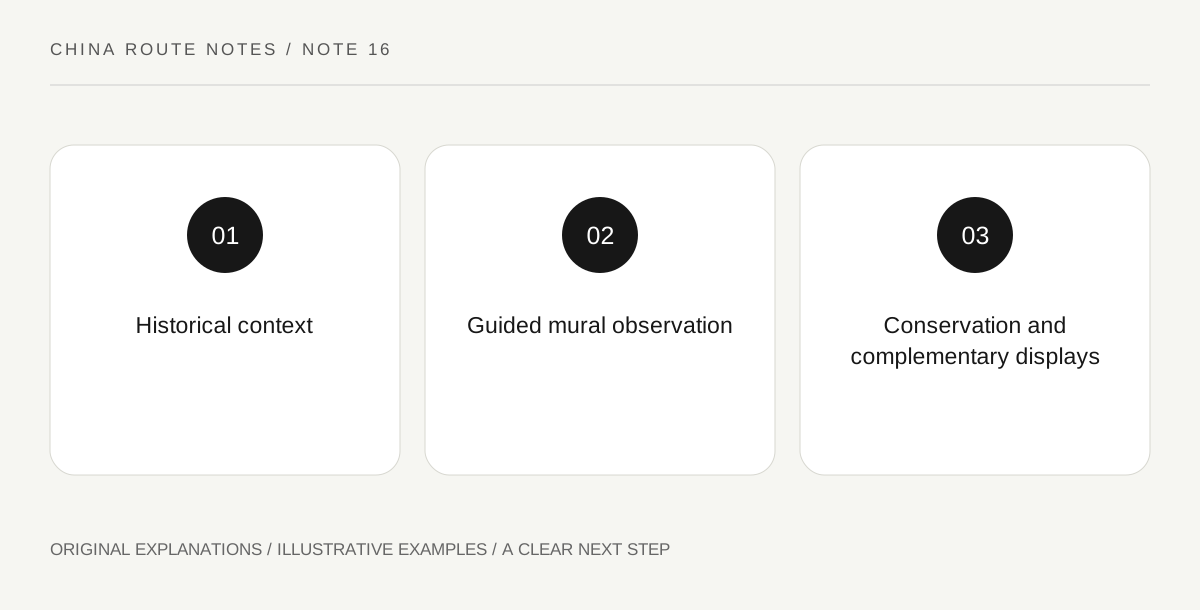
Original explanatory diagram. Read the full method and limitations below.
Begin with the site’s position in cultural exchange
UNESCO situates Mogao near Dunhuang and emphasizes its long development as Buddhist art at a Silk Road crossroads. That context suggests looking for relationships between religious subjects, patrons, artistic forms and travel across regions. It does not mean every painted detail can be traced to one distant origin by sight alone. Before visiting, learn the broad distinction between a devotional figure, a narrative scene and an image of a donor where reliable interpretation supplies it. These categories give you questions to ask without requiring you to identify every figure from memory.
Read one wall in layers of attention
If the authorized visit permits, begin with the overall composition before moving to individual figures and decorative details. Ask where the principal focus lies, how smaller scenes relate to it and whether the guide identifies a narrative sequence. Notice the difference between something you can see and a subject established by scholarship. A photograph in a book can help later, but should not be used to insist on unauthorized lighting, touching or photography inside the cave. Follow the actual guide and site rules. A brief, attentive observation can be more useful than struggling to record every surface at once.
Accept that cave selection is not a personal checklist
Current tickets, visitor programs and cave access need to be established through the site’s official visitor channels. Do not assume a cave shown in an online article is included in your program or open on the day. The heritage property contains a large body of work, while a managed visit necessarily samples it. Ask what the offered selection helps explain: a period, architectural arrangement, painting subject or conservation issue. If you have a specialist interest, investigate an appropriate official program in advance. Buying ordinary admission and arriving with a private wish list does not create access to restricted spaces.
Give the guide a precise conservation question
Ask how the visitor arrangement protects the art and what kinds of changes conservation teams monitor, without demanding an improvised technical diagnosis from a brief glance. Darkness, limited group movement and restrictions can be meaningful parts of stewardship. Distinguish preserved original fabric from a reproduction or digital presentation when the interpretation identifies it. Reproductions are valuable for seeing details that a cave visit cannot expose freely. Use them as complementary evidence rather than as proof that access limits make the original less worthwhile. Your final notes can combine a cave observation with an explanation seen in a permitted exhibition.
Illustrative mural note
A visitor selects three prompts: principal figure or focus, relationship of smaller scenes, and one conservation point explained by the guide. After leaving the cave, the visitor writes a short account from memory and checks subject names against the official interpretation. Any uncertain identification remains a question rather than becoming a confident caption on a shared photograph.
Practical checks
Optional checkboxes save only in this browser.
Questions that come up
Can I choose every cave I want to enter?
Do not assume so. Access is managed and depends on the current official program. Investigate specialist options in advance and understand the selection included in the ticket you actually purchase.
Are digital displays a substitute for the original caves?
They can reveal details or context that are difficult to study during a controlled cave visit. Use both forms for their different strengths, while clearly distinguishing reproductions from the surviving original artwork.
References and scope
These sources support the factual background. Examples and exercises are original illustrative teaching material. References do not imply endorsement.
- UNESCO: Mogao Caves — Buddhist cave art, Silk Road exchange and conservation context.