Lijiang Old Town: Follow the Water and Respect the Neighborhood
Lijiang’s historic townscape includes a functioning water system and architecture shaped by cultural exchange. A visit can follow those relationships without reducing the town to souvenir streets. Pay attention to where water travels, how streets fit the terrain and where public circulation ends at someone’s home.
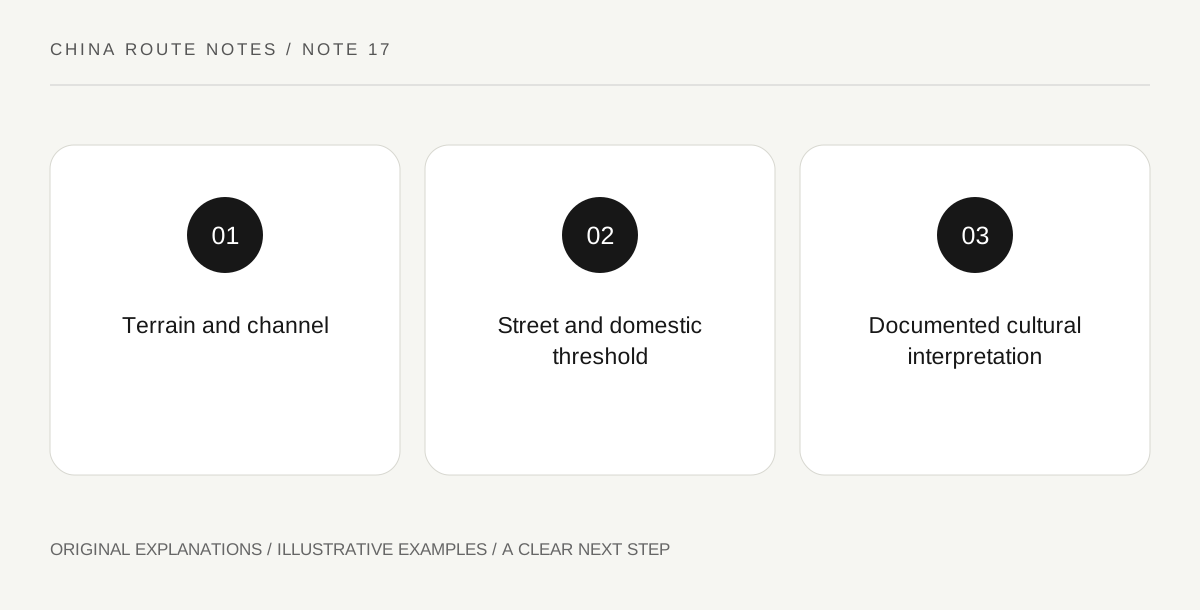
Original explanatory diagram. Read the full method and limitations below.
Start with terrain and water rather than shops
UNESCO emphasizes Lijiang’s adaptation to uneven topography and its sophisticated water-supply system. Those features suggest an observation route built around channels, bridges and changes of level. At a public point where stopping is appropriate, look at the direction of flow and the relationship between water and the street. Do not assume the channel is decorative because it appears picturesque. A functioning urban system can have meanings and uses that are not obvious to a passing visitor. Use official interpretation for specific historical purposes rather than inventing them from a photograph.
Distinguish town fabric from individual premises
An old lane may be publicly accessible while a courtyard opening beside it belongs to a household or business. Ask before entering, photographing people closely or treating a domestic doorway as a viewing platform. Keep bridges, narrow lanes and entrances clear. If a local guide explains a building, establish what can be seen from the permitted area and whether interior access is actually offered. Buying an item nearby does not create permission to enter someone else’s residence. This practical distinction lets you observe the town’s living architecture without turning residents into an exhibit.
Give cultural interpretation a named source
Lijiang’s heritage account discusses cultural exchange and local traditions, including Naxi heritage. Avoid describing everything visible as one unchanged or uniform ethnic style. Ask which community, period or documented practice a guide is explaining. A modern shop selling a symbol may tell a different story from a historical building or cultural institution presenting it. If you purchase work labeled with a cultural association, ask who made it and how the description is supported. You can appreciate a design without repeating an uncertain origin story. Accurate captions are especially important when sharing images outside their original context.
Choose a route that can be retraced
Before wandering through similar-looking lanes, mark a clear meeting place and an accessible way back to accommodation. Record the exact lodging address, since a romantic property name may be difficult to locate in a historic street network. Ask the host about luggage access and the permitted vehicle drop-off rather than assuming a taxi reaches the door. Use the water system as an observation theme, not as the sole navigation method; channels branch and a picturesque lane can lead away from your destination. A short loop with a few attentive stops leaves more room for meaningful looking than repeated attempts to find the same lost junction.
Illustrative neighborhood walk
A visitor chooses a public bridge as the starting point, observes two channel-street relationships and visits an officially interpreted cultural display. The return route is marked before the walk. A courtyard door is left unentered when its status is unclear. The notes distinguish visible water flow, a documented historic explanation and a question to ask the guide later.
Practical checks
Optional checkboxes save only in this browser.
Questions that come up
Are all picturesque courtyards open to visitors?
No. Some are homes, working premises or restricted areas. Use signs and explicit permission rather than assuming an open doorway is an invitation.
Can the waterways guide me back to my hotel?
They can enrich observation but are not a reliable substitute for the actual address and route. Record the lodging’s location, meeting point and luggage-access instructions before exploring unfamiliar lanes.
References and scope
These sources support the factual background. Examples and exercises are original illustrative teaching material. References do not imply endorsement.
- UNESCO: Lijiang — Historic town, cultural exchange and water-supply system.