The Forbidden City: Read the Courtyards Before Counting the Halls
The Forbidden City becomes more intelligible when its spaces are read as a sequence. Instead of treating every hall as another photograph, notice how axes, gates, courtyards and changes in scale organize movement. This approach gives a first visit a clear theme without requiring encyclopedic knowledge of every building.
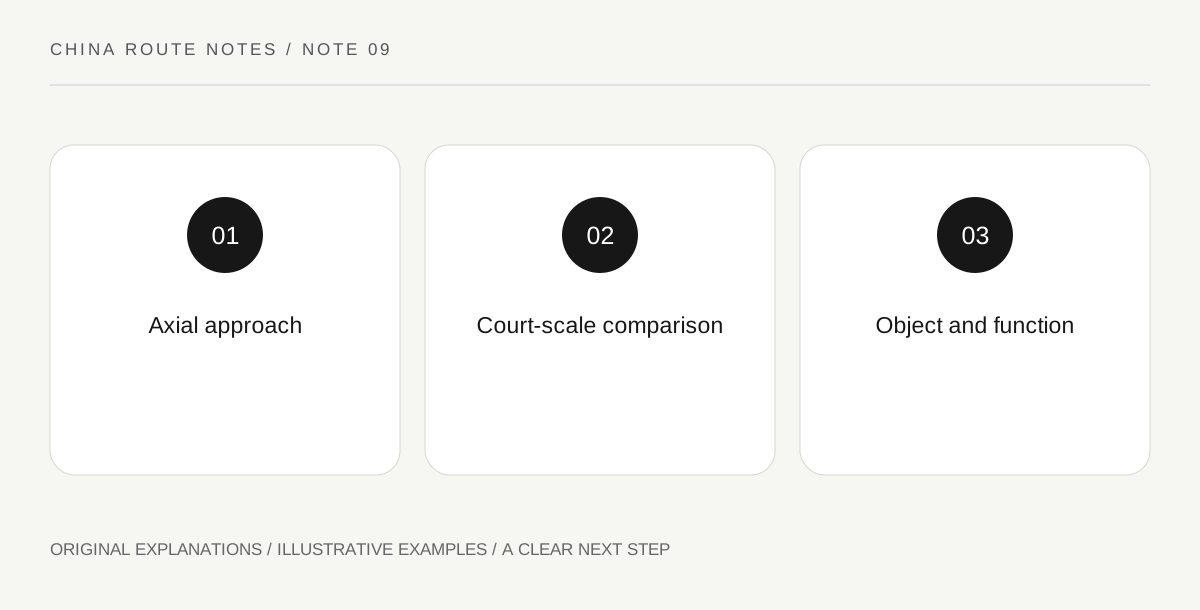
Original explanatory diagram. Read the full method and limitations below.
Begin with the axis as a question
UNESCO describes the Beijing palace’s central axis, symmetry and relationship between outer and inner courts. Use those features to ask how the complex directs a visitor’s attention. Stand where public access permits and notice whether the next gate appears centered, screened or delayed by the intervening space. The exercise is observation, not a claim that every visible feature retains its original use unchanged. A modern visitor route is also shaped by museum operations. Separate the historical arrangement of the palace from the practical path you are allowed to follow on the day.
Compare ceremonial scale with smaller settings
At a broad court, look at the relationship between open ground, terraces, entrances and the principal building. Then compare that experience with a more enclosed space later in the permitted route. Ask what changes when a building is approached across a large exposed court rather than through a smaller enclosure. Avoid reducing the entire palace to the idea that everything was a bedroom or throne room. Official interpretation can explain functions that appearance alone cannot establish. A building’s size gives you a productive question about hierarchy, but its name, date and documented use provide the evidence needed to answer it.
Give one display enough attention to explain itself
If an exhibition is open and fits your ticket, select a small group of objects instead of rushing through every cabinet. Read the label for material, date, function and provenance. Ask how the object connects to court life rather than judging only its decoration or monetary value. A vessel, garment or document can reveal a different aspect of the palace from the architecture outside. Keep special exhibition admission and general entry separate in your booking research. Neither a UNESCO listing nor a photograph of an exhibition establishes what rooms or collections will be accessible during your visit.
Make the route serve the theme
Check the museum’s current booking, identity, opening and entry arrangements directly. Then identify a small number of observation goals: one major axial view, one contrast of court scale and one object study. Leave capacity for walking between them. Do not turn the theme into a rigid hunt that leads you against barriers or into closed areas. A useful note might describe how a gate frames the next court rather than list twenty building names. If crowds prevent a long stop, make a short observation from a permitted position and continue. Architectural understanding grows from comparing relationships, not occupying the perfect photograph spot.
Illustrative visit notebook
A visitor writes three prompts before entering: Where is the main axis visible? How does the size of a court affect my sense of approach? Which displayed object explains a documented court activity? The resulting page contains a simple plan, two spatial comparisons and a label-based object note. It is a learning exercise rather than a complete palace itinerary.
Practical checks
Optional checkboxes save only in this browser.
Questions that come up
Must I recognize every hall to enjoy the palace?
No. A few well-chosen relationships can provide a coherent first reading. Use the official plan and labels to establish names and functions, then compare scale, sequence and framing along the permitted route.
Does the UNESCO entry tell me how to reserve a ticket?
Its purpose is explaining heritage significance. Booking windows, passport procedures, exhibition access and temporary closures belong to the museum’s current visitor information and may change independently of the heritage description.
References and scope
These sources support the factual background. Examples and exercises are original illustrative teaching material. References do not imply endorsement.
- UNESCO: Imperial Palaces — Beijing palace hierarchy, central axis, outer and inner courts.