The Grand Canal: Turn a Waterfront Walk Into an Infrastructure Story
A canal-side walk can reveal more than reflections and old bridges. China’s Grand Canal linked water transport, state administration and the movement of essential goods. Choose a particular local reach and ask how its banks, crossings and surviving structures connect to that larger system.
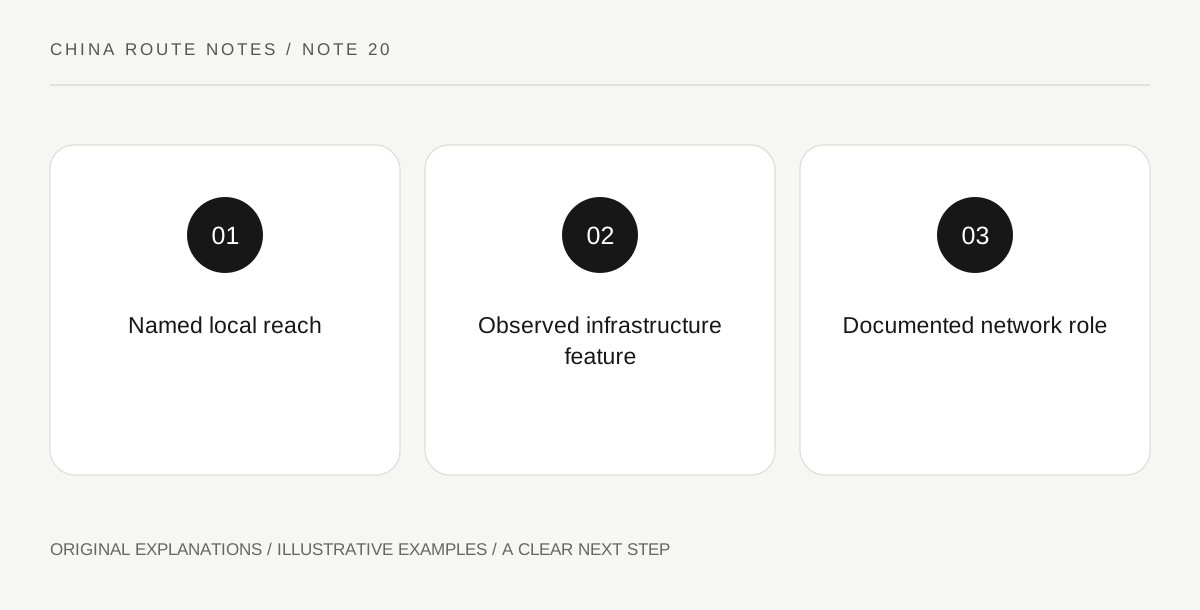
Original explanatory diagram. Read the full method and limitations below.
Identify the reach rather than the entire canal
The UNESCO property is a serial collection of waterways and related features across a vast area. It is not a single continuous tourist promenade with one entrance or operator. Name the city, canal section and institution you intend to visit. A local waterway may connect with the Grand Canal story without every visible feature belonging to the listed property. Use official maps and interpretation for those distinctions. This precision also makes navigation easier: a broad search for Grand Canal can return places far beyond the neighborhood you are exploring, while a named reach produces a useful local starting point.
Look for movement, crossing and storage
At a public section, organize observations around how goods or people move along, across and beside the water. A bridge shows crossing; a landing or quay may suggest loading; a documented warehouse can connect the bank with stored goods. Let labels establish historical functions rather than assigning every attractive waterside building a grain-storage role. Ask what evidence survives and what has been reconstructed or adapted. A modern café in an old building can be part of the present waterfront while its earlier use needs a separate explanation. Recording those layers is more informative than choosing only the oldest-looking facade.
Connect local form with an administrative system
UNESCO explains the canal’s role in the historical transport and storage of grain and other essential goods, alongside taxation and imperial administration. Use that context to ask who coordinated movement and how the waterway supported cities and populations. A museum display may supply the local chronology, cargo evidence or engineering detail needed to make the link concrete. Avoid describing every part of the system as equally active in every dynasty. Political centers, routes and transport practices changed. A dated local example is stronger than a sweeping claim that one arrangement governed all canal trade for centuries without alteration.
Pair the walk with one piece of interpretation
Choose a local museum, official display or accurately interpreted structure that answers a question raised by the walk. If you notice a level change, seek an explanation of water management; if you notice a landing, investigate cargo handling. Then return mentally to the feature and see how the explanation changes your understanding. Confirm current opening hours and access with that venue, since the heritage record is not a daily visitor schedule. Keep the route on public paths and respect operational waterways. Working banks and vessels are transport environments, not invitations to step onto infrastructure for a better viewpoint.
Illustrative local reach study
A visitor chooses one named canal reach, records a public bridge and a documented former loading point, then visits a nearby official exhibit about local grain transport. The notebook distinguishes the feature seen today, its documented earlier role and its place in the wider network. The result is a connected infrastructure story from a short walk.
Practical checks
Optional checkboxes save only in this browser.
Questions that come up
Can I visit the entire Grand Canal in one city?
No. The heritage property spans separate components over a very large area. A city visit can examine a particular reach and connect it with the broader network through reliable interpretation.
Is every old building beside the canal a warehouse?
No. Location and appearance alone do not establish a function. Use records, labels or a reliable guide, and distinguish historic use from modern reuse.
References and scope
These sources support the factual background. Examples and exercises are original illustrative teaching material. References do not imply endorsement.
- UNESCO: Grand Canal — Serial waterway infrastructure and historical grain transport.