Dujiangyan: Follow the Water Before Adding Qingcheng Mountain
Dujiangyan is easier to understand as an operating water-management idea than as a collection of bridges and viewpoints. The UNESCO property also includes Mount Qingcheng, a separate cultural component. Decide whether your day is about irrigation engineering, the mountain’s Daoist heritage or a feasible combination of both.
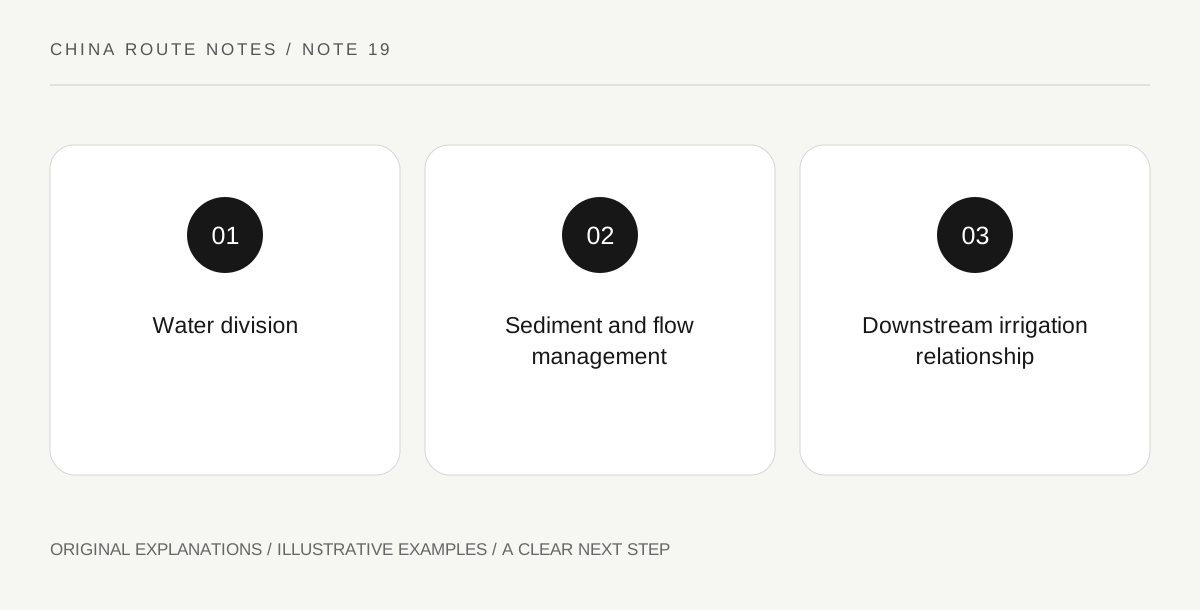
Original explanatory diagram. Read the full method and limitations below.
Locate the system and its purpose
UNESCO describes Dujiangyan as an irrigation system that uses topography and hydrology to divert water, control flow and handle sediment. Its history reaches back to the third century BCE, with later modifications. The useful visitor question is how those functions relate, not simply which feature is oldest. Begin with an official diagram showing the upstream water and the main channels. Distinguish the water-management system from modern visitor bridges, viewpoints and service facilities. Each can help you see the site, but they should not all be assigned the same historical role because they appear in one photograph.
Trace one flow relationship at a time
Use the official interpretation to identify the Yuzui division, Feishayan and Baopingkou components and their respective roles. Then connect one explanation with a visible relationship in the landscape from a public viewing area. Ask where water is divided, where excess flow or sediment is managed, and where a passage directs supply onward. The scene on a particular day reflects actual conditions, so avoid treating one observed water level as the permanent state of the system. A functional sketch should use arrows and named points rather than attempt to imitate a technical engineering drawing you cannot independently verify.
Connect infrastructure with the cultivated plain
The heritage significance extends beyond an impressive local structure to the management of water for the Chengdu plain. Ask how a local intervention changes conditions downstream and what continuing maintenance means for a system with a long history. Ancient does not mean untouched. Modification and care can be central to the survival of working infrastructure. When reading a display, distinguish the original principle, later alterations and present management. That sequence helps explain why a living system differs from a static ruin. Do not infer from the visible scene that every operating decision is automatic or identical throughout the year.
Treat Qingcheng as a separate visit decision
Mount Qingcheng contributes a Daoist religious landscape to the same UNESCO property, but shared listing does not make it the same entrance or the same physical effort. Check the current travel connection and specific mountain route if you want to include it. Decide what you would remove from the day to allow the second component enough attention. A rushed arrival at another gate after an engineering visit may produce two incomplete experiences. If your interest is primarily water management, spend time with the site interpretation instead. If religious architecture is your priority, build the day around that component from the start.
Illustrative engineering sketch
A visitor draws three named points and uses arrows to connect the water-management functions explained on the official display. At a permitted viewpoint, the visitor compares one visible channel with the diagram and notes the day’s observed conditions. Qingcheng is reserved for another day because its route and subject deserve a different pace. This is a learning scenario, not a timed itinerary.
Practical checks
Optional checkboxes save only in this browser.
Questions that come up
Are Dujiangyan and Qingcheng one walkable attraction?
A shared UNESCO listing does not establish a single visitor route. Check the particular entrances, transport connection and physical demands before combining the two components.
Does ancient engineering mean the system has never changed?
No. The heritage account describes later modification and enlargement. Working infrastructure survives through maintenance and adaptation as well as inherited principles, so read the chronology supplied by the interpretation.
References and scope
These sources support the factual background. Examples and exercises are original illustrative teaching material. References do not imply endorsement.
- UNESCO: Qingcheng and Dujiangyan — Ancient irrigation engineering and distinct Daoist mountain component.